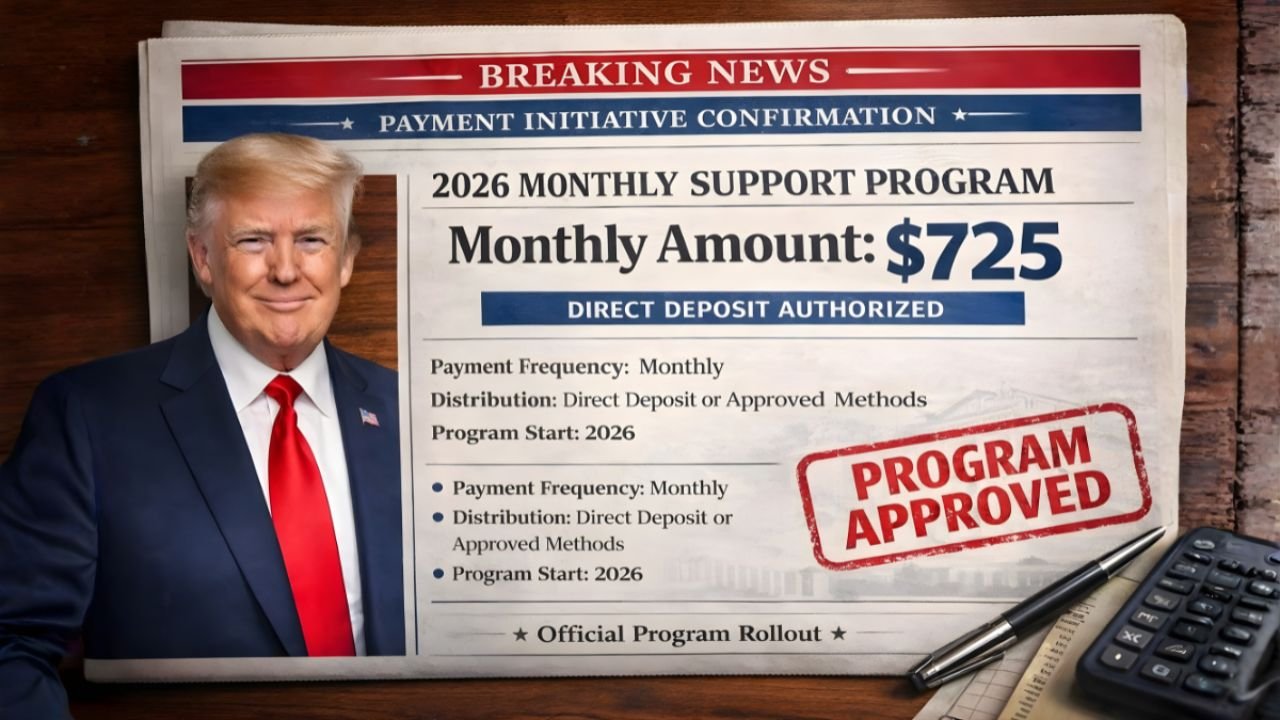
A significant policy development in 2026 has introduced a new $725 monthly payment initiative designed to provide recurring financial support to eligible households. Unlike short-term stimulus checks issued during emergencies, this program follows a structured monthly model aimed at delivering predictable income over a defined period.
With inflation continuing to influence housing, groceries, healthcare, and transportation costs, policymakers are increasingly exploring guaranteed income frameworks that offer stability rather than one-time relief. The $725 initiative reflects that shift—focusing on consistency, budgeting confidence, and long-term financial resilience.
What Is the $725 Monthly Payment Initiative?
The program is structured as a recurring income support model. Eligible participants will receive $725 per month under clearly defined guidelines. Instead of a lump-sum payment, funds are distributed on a scheduled monthly basis.
This approach allows recipients to integrate the payment into their regular budgeting cycle. For many households, predictable support reduces financial uncertainty and improves planning for essential expenses.
While details may vary depending on jurisdiction, the initiative is broadly aligned with guaranteed income principles—providing direct cash assistance without overly restrictive spending requirements.
Why Recurring Payments Matter

One-time relief payments can help address urgent needs, but they often do not solve ongoing financial strain. A recurring payment model creates a steady income stream that households can rely on month after month.
Supporters of the initiative argue that predictable income:
- Reduces financial volatility
- Improves long-term budgeting decisions
- Decreases reliance on high-interest credit
- Strengthens housing stability
- Supports consistent access to healthcare and nutrition
By delivering structured support, the program aims to help families move beyond crisis management toward sustainable financial planning.
Who May Qualify for the $725 Payment?

Eligibility is expected to focus primarily on income-based criteria. While final rules may vary by location, most guaranteed income models prioritize low- and moderate-income households.
Likely Eligibility Categories
Potential qualifying groups may include:
- Low-income individuals and families
- Households with dependent children
- Seniors living on fixed incomes
- Individuals facing housing instability
- Workers in economically vulnerable sectors
Residency requirements may apply, and applicants will likely need to provide documentation verifying income, identity, and household composition.
Participation in other assistance programs could influence eligibility depending on program design. Administrative systems typically review applications to confirm compliance with income thresholds and residency standards.
Meeting all required conditions is essential before payments begin.
How Payments Will Be Delivered
For approved participants, payments are expected to be distributed primarily through direct deposit. Electronic transfers remain the fastest and most secure delivery method.
Individuals without banking access may receive funds through alternative approved channels, such as prepaid debit systems or designated payment services.
Administrative safeguards—including identity verification and enrollment confirmation—are designed to protect the integrity of the program. These measures help ensure that funds reach eligible recipients and reduce the risk of fraud or administrative errors.
Timely responses to official communications are important to avoid enrollment delays.
Why Policymakers Introduced the Initiative
The launch of the $725 monthly payment initiative reflects broader economic trends in 2026. Policymakers have cited sustained inflation, rising housing costs, and wage gaps as key drivers behind the program’s introduction.
Rather than relying solely on emergency relief tools, officials are increasingly exploring income stability models that provide continuous support.
Supporters believe recurring payments can:
- Improve financial decision-making
- Reduce stress associated with unpredictable income
- Encourage long-term planning
- Strengthen community economic resilience
The initiative aligns with a growing policy focus on addressing structural financial challenges rather than isolated economic shocks.
How the Program Will Be Evaluated
During its rollout phase, the initiative is expected to undergo ongoing evaluation. Program administrators may assess:
- Participation rates
- Economic impact on households
- Administrative efficiency
- Cost-effectiveness
- Broader community outcomes
These evaluations will likely determine whether the program is expanded, modified, or extended beyond its initial timeframe.
Data-driven reviews are common in guaranteed income models to measure real-world financial impact and long-term sustainability.
What This Means for Eligible Households
For households that qualify, the $725 monthly payment offers structured financial support during a period of continued economic adjustment.
A consistent monthly deposit can help cover essential expenses such as:
- Rent or mortgage payments
- Utility bills
- Transportation costs
- Groceries
- Healthcare expenses
More importantly, the recurring structure allows recipients to plan with greater confidence. Instead of reacting to short-term financial gaps, families can incorporate the payment into a comprehensive monthly budget.
Financial stability is often built through predictability, and that is the core principle behind this initiative.
Staying Informed
As with any government-supported program, official communications should be the primary source of information. Enrollment timelines, documentation requirements, and payment schedules may vary depending on location and administrative guidelines.
Applicants are encouraged to:
- Review official eligibility announcements
- Submit complete and accurate documentation
- Monitor enrollment confirmations
- Keep contact information updated
Relying on verified sources helps prevent misinformation and ensures compliance with program requirements.
Final Thoughts
The $725 monthly payment initiative marks a notable shift toward recurring income support in 2026. By offering predictable monthly assistance instead of one-time relief, the program aims to strengthen household stability in an environment of sustained economic pressure.
For eligible participants, consistent deposits may provide not just financial support—but greater confidence in managing the months ahead.
Disclaimer: This article is for informational purposes only and is based on publicly available program details and general guaranteed income frameworks for 2026. Eligibility requirements, payment schedules, and administrative procedures may vary by location and official guidelines. Individuals should rely on authorized program communications for accurate and legally binding information.